Showing posts with label Jane Jacobs. Show all posts

Wednesday, April 30, 2014

City Planning as a Social Movement, What it Means to be an Urbanist

Throughout the history of city planning, and except for a brief period in the 1960s, it has never directly entered the public mindset as something that can bring about social justice and lead to better living. 


Cities are the building blocks of nations. They are economic powerhouses which have developed or manufactured each and every technological advance in the history of the human race. Cities are the cornerstone of modern society. But cities are even more than that:

“Cities are for people. A place for their hopes and dreams, their work and play, their homes and homes for their children. Cities are alive and have personalities, each different from all others and each in constant change.”
-Richard Bartlett, AIA.

As I note in the banner of this blog, how we design and use our environments directly relate to the quality of interactions we have with and within them. These interactions can include everything from the mundane, such as buying groceries, to the extreme, such as criminal activity.

Cities are built by people and for people. As residents of cities, or as those who have reaped the benefits of cities, we have a responsibility not only to ensure their continued prosperity, but to ensure that the social, economic, and cultural benefits they bring reach the largest number of people and do the greatest amount of good. It is our responsibility to ensure that cities meet the needs of all social and economic groups, that cities can provide safe places for children as well as homes for the elderly. It is our responsibility to ensure that the penthouse apartments for the wealthy do not detract from the provision of housing for those on the margins of society.

Moreso, it is our responsibility to ensure that the economic and societal collapse of the 1960s and 1970s, mainly due to urban decay, does not repeat itself. We must make sure that our cities are resilient, both economically and environmentally. We must build for the desires of the present, while planning for the future; realizing that while bars and nightclubs may be desirable now, schools and grocery stores will be needed in the years to come. 


To this end, ensuring comprehensive multimodal transportation is the responsibility of every citizen, and we all have something to gain from it. Americans spend almost one third of their income on transportation, only to receive increasing commutes, increased stress levels, increased pollution, and longer work days. This is not sustainable in any way. Our love of the automobile has fractured our social networks, brought our environment to the verge of destruction, and caused our lives to revolve around the price of gasoline, not to mention the 30,000 deaths per year as a result of automobile wrecks.


We also have a responsibility to keep our cities free of crime. This does not have to mean an increase in the police force, however. The design of our cities in and of themselves can deter crime, something which was realized as long ago as the 1960s. This, along with a fundamental rethinking of policing strategies, as brought to the table by David Kennedy, is something that it is our responsibility to advocate for. It is the job of a city to bring people together and foster social, as well as intellectual, collaboration regardless of race, class, or gender. Crime does the opposite of this. It separates communities, often across racial lines, and fosters negative stereotypes.


Finally, and on a more personal level, the design of our environment impacts our health. Perhaps the ultimate solution to our healthcare costs lies not in the halls of congress, but in our methods of development. Our fascination with automobiles and drive-throughs has led to an explosion in the popularity of fast food and a dramatic increase in distance between travel points. A recent article in USA Streetsblog notes that only in three cities in the entire country, New York, Philadelphia, and San Francisco, is it possible for a majority of residents to walk to a grocery store in five minutes or less. If we spent more time walking or riding our bicycles to the store and spent less time eating fast food in our cars, perhaps we could reduce our record rates of obesity and heart disease. If we consolidated our development and devoted more money to inner city economic development, perhaps we could alleviate the food desert issue that plagues so many low income communities.


However, none of these aspects can be looked at in their own field of influence. It is impossible to encourage more people to walk or bike in a community that is rife with crime. Likewise, it is impossible to encourage economic development and business investment without building a vibrant and resilient community. Finally, it is downright negligent to constantly mourn victims of mass shootings without paying attention to the fact that the majority of mass shootings occur in suburban areas. 


This is what the idea of urbanism is. Not just understanding the world around us and how we interact with it, but also realizing that the built environment is one that we all influence, whether we realize it or not. To borrow (and modify) a phrase from Matthew Taylor, the Chief Execuitve of the Royal Society for the Arts, I believe that the use of our urban space can “tell us about who we are as human beings, spark political debates about who we need to be, and lead to philosophical debates about who we aspire to be”. The goal of urbanists is to spark and lead these discussions, turning inclusive thought and deliberation into policy.

This sentiment was expressed over 50 years ago by Jane Jacobs, in her landmark book Death and Life of Great American Cities, which brought planning into the realm of the general public for the first time:

“Cities have the capability of providing something for everybody, only because, and only when, they are created by everybody.”


Friday, February 7, 2014

Modernism Revisited, Was Jane Jacobs Right?

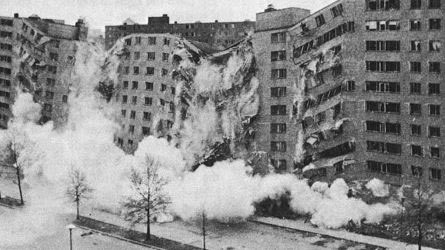
I recently had an opportunity to view the documentary The Pruitt-Igoe Myth, which I touched upon earlier in this blog. In this film, many residents of the infamous public housing development reflect upon the time they lived there, the community that existed, and it's ultimate undoing.

The residents interviewed for the film, some who had lived in the development since the beginning, others who moved in during its period of decline, all noted that throughout the lifetime of Pruitt-Igoe, a strong community developed, first based on the joy and pride that came from living in such a new, modern place, and later as a counter to the decline of the complex and its neglect by local, state, and federal housing officials.  

The documentary notes that what caused the ultimate undoing of the development, a post-industrial city with a declining population, miscalculations of growth, and policy, both formal and informal that maintained the racial segregation of St. Louis's housing stock, keeping African Americans from entry-level jobs, had little to do with the modernist movement, architectural features of the buildings (or lack thereof), or the quality of the community created within them.  

Jane Jacobs, in her landmark Death and Life of Great American Cities notes that housing developments such as these will inherently fail due to their architectural characteristics, such as massive scale, large open spaces with little use, and lack of economic diversity or mixed uses. However, from this documentary it is apparent that such a community did develop, and that, for a time, it was able to benefit and look after the residents of Pruitt Igoe.

Ultimately, the downfall of this community, and the housing complex, was caused by insufficient maintenance, a shrinking population, and a bureaucracy that ultimately was apathetic to such problems as they affected many similar public housing units around the country. In other words, the massive resources that a public housing development of this scale needed to succeed were not available.


In this sense, the point Jacobs makes is that development or refurbishment is most efficient and useful if it occurs in forms already recognized in the neighborhood it is located in, as this development can be supported by existing infrastructure, with existing means. In order to work properly, modernist public housing on a large scale would require massive amounts of continued funding, which would likely be unsustainable.  

Jacobs notes this, and tells the reader that when the word “project” is used to describe such a development, it conjures very specific things, namely that the development, and those who live in it, are fundamentally different than their surroundings. Death and Life of Great American Cities describes in detail how cities can be revitalized by using their intrinsic characteristics, a much less intrusive practice than the modernist approach, and one that is ultimately more sustainable.

In this way, the film's claim that Pruitt Igoe should not be used as an example of modernist failings is somewhat inaccurate. Pruitt Igoe demonstrated that the modernist approach would work as long as large sums of money were provided over the lifespan of modernist developments. The political reality prevented (and continues to prevent) such sums of money being spent on public housing, necessitating a more efficient approach.


It can be argued that Jacobs approach to housing is more practical because it uses the intrinsic features of an urban environment to promote social and economic growth. This prevents unnecessary sums of money being spent on imposing “order” on an “chaotic mess”to use descriptions common amongst modern architects and correcting what is actually a non-problem.  

This is the core reason that large scale public housing complexes such as Pruitt-Igoe should not be repeated, they are the hallmark of construction for construction's sake, and only work if continuously supplied with funding.

Monday, August 19, 2013

On Detroit

The bankruptcy of Detroit has sent a shock wave through the economic community and has caused much discussion about the continued provision of pensions and other "entitlements" by municipal governments. Such discussions follow the popular debate about public sector unions, but fail to take into account elementary knowledge of planning and economic efficiency. Detroit's development went against several guidelines noted primarily in Jane Jacobs' The Economy of Cities which describe how cities grow, develop, and adapt to change. Ironically, this book used Detroit as an example of how cities should develop sustainably.


1: Lack of Economic Diversity
Detroit was developed as an industrial city, and for many decades that industry and its exports were widely varied, from ship building to agricultural and industrial machinery to tools to automobiles. Jane Jacobs takes note of this and describes that a city must have diversity in its economy in order for it to adapt to change. During the second half of the 20th century, Detroit's industry began to converge on one product, automobiles. This was well and good for the brief period before automation of assembly lines and competition from foreign manufacturers. This quickly changed, as assembly lines started to automate, less manpower was required to operate factories, and legions of workers were let go. In addition, as manufacturers such as Honda and Toyota came into the American market, offering what was widely perceived to be a superior product, the demand for domestic automobiles started to decline. The fact that Detroit's main export was automobiles meant that factory workers who were laid off had few employment alternatives.


2: Sprawl
Detroit's horizontal growth (attributable in no small part to it's main export) exponentially increased the amount of money that needed to be spent to provide public services to its residents. More police and firefighters were needed to cover more land, more schools had to be built and more teachers and staff hired to operate them, more hospitals and clinics needed to be built, and more roads needed to be maintained. This not only required the city spending money to build and maintain public structures and hire people necessary to operate them, but also required private residents to pay higher taxes to maintain those services, spend more on transportation, living, and healthcare. The city is now unable to maintain this infrastructure, and vacant houses have been torn down in droves.


3: Corruption
Despite the fact that the monetary losses from the city pale in comparison to its debt, this is a major consideration. Detroit is famous for its corrupt city officials. It's mayor, Kwame Kilpatrick, has been investigated multiple times by the federal government and accused of laundering money through a variety of front companies. In addition, many current and former council members have been charged with corruption. Clearly, the city's politicians are not motivated to solve problems such as economic resiliency, poverty, and crime.


In order for a city to be sustainable, it must be economically resilient. Detroit did not plan for this (perhaps due to the fact that the interests of its politicians were elsewhere) and, predictably, failed. Cities must insure adequate economic diversity for continued survival and the well being of their residents.

Saturday, December 29, 2012

Mass Shootings and Suburbanization

Whenever a mass shooting occurs, public opinion focuses on one of three things: guns, video games, or mental illness. Where and how we live, a prominent aspect of our culture, is rarely discussed in relation to increasing violent tendencies.


Most mass shootings have occurred in suburbs or small towns, not in cities. This includes the Virginia Tech shooting, Columbine High School, and most recently, Newtown, CT. A recent study by the Brookings Institute showed that as the crime rate for inner cities is decreasing, the crime rate for suburban areas is increasing.  

Likewise, poverty is shifting from the inner cities to the suburbs. This is due to both the special severity of the financial crisis in account of the pervasiveness of mortgages, and the fact that suburban living is highly decentralized and infrastructure intensive, and thus has higher living costs.


The ways suburbs are planned and built runs contrary to the ways the built environment is intended to work for people. Jane Jacobs notes how shared and varied land uses promote use of outdoor space and socialization with other users of that space. This goes for adults as well as children, as she notes that when children play on sidewalks or in alleys they are indirectly protected by public surveillance of the streets.

This is a process that is not allowed to occur in suburbs chiefly because land is segregated by use. There is no incentive for those who live in residential neighborhoods to survey their streets because nothing of interest is taking place on them. Likewise, residents of suburbs are also less likely to use sidewalks on their streets because of the lack of destinations reachable on foot and the fact that fences have been erected around yards, prohibiting residents from interacting with each other via streets.


In addition to this, a growing amount of research is being done on the mental health effects of pollution and traffic congestion. An article in the Wall Street Journal notes that research has found possible links between air pollution and Altzheimer's, Parkinson's, and Autism, as well as increased levels of stress. Traffic congestion has also been linked to increases in stress.  


This stress, combined with the few opportunities for socialization provided by suburban life and the easy access to weapons in American society no doubt contribute to our high rates of gun violence and mass shootings. If mass shootings are a problem we wish to address responsibly and permanently, we need to look at the way we live and how it shapes us.

Saturday, June 23, 2012

Urban Economic Development

The two works which inspired this post are The Economy of Cities by Jane Jacobs and “Alleviating the Financial Capital Barriers Impeding Business Development in Inner Cities”, A study by Timothy Bates.

In Jacobs' 1970 book, she not only lays out her theory that cities developed before agriculture, but also explains her theories for urban economic growth, the import-replacement effect, the export-multiplier effect, (which operate in tandem) and the addition of new work. In short, they state that as a city grows, its development of manufactured goods will allow it to produce domestically goods which it previously imported, and then add these goods to its exports to other cities. The principle of the addition of new work states that as these imports are converted to exports, ideas for new exports and new processes for making these new exports are derived, thus creating more economic opportunities.


However, the economic engine of cities (and of the United States as a whole) has changed radically since the 1960s. Commercial service has replaced industry as the driving economic force, and with the exception of highly specialized manufacturing (streetcars, airplanes, and medical equipment, for example), this is likely to remain the case. It also depends on the abilities of a city's educational system, for adding new work to old requires a constant supply of creativity, something that schools are increasingly unable to provide given standardized curricula and benchmarks based on standardized tests.


On the other hand, Bates' study focuses on the perils of inner city and minority run businesses, including access to start up capital through various means. Bates' study, however, does not discern small businesses from larger corporations that happen to be minority run or located in inner cities.


In his study, he focuses primarily on testing and debunking claims made by Michael Porter, such as urban areas representing untapped markets and logistical advantages present in inner cities.

Bates did not find that these claims held true, he also noted that a venture capital fund set up by Porter to test these theories was profitable due to its investments in ventures not located in inner cities, which balanced out investments in inner city firms.

However, Bates did find that there were substantial roadblocks to inner city firms who desired capital and credit, and his study examined efforts already in place to mitigate these as well as proposing new solutions.


One promising solution Bates examined was that of a firm called Medallion Funding, that would provide loans when given capital to back the loans up on (taxi medallions in New York City, or dry cleaning equipment for laundromats, for example). He states that this method holds promise, because it can both diversify and cater to smaller establishments, as it can recoup failed loans by selling off this capital.

To extend this into a firm that can provide start up capital for any type of small commercial businesses or boutique manufacturing company, a large organization would be required. This is so it can diversify its holdings and better absorb the failure of some companies it lends capital to, a reality in a market driven society. However, this organization would also need to be able to tailor itself to the needs of a specific city or even a specific neighborhood or district within a city.

Also, this organization would need a reliable source of capital to back the loans given out to urban businesses. One possibility is the building that the business is located in, which could be repossessed and sold off or re-leased for substantially more than the amount of the original loan.

Thursday, March 15, 2012

On Streetscape Design

Some of the most important features of an urban area are street layout and street design. These are responsible for not only transporting people, but also for promoting interaction with other people and with the surrounding environment. The design of an area's streetscape says much about how the area is used by those who live and work in it, as well as what kind of interaction it is intended for. The streetscape is composed of several components: sidewalks, the street itself, landscaping, and the design and orientation of buildings along the street.

The first aspect I will be examining is the sidewalk. Sidewalks serve many purposes, the transportation of pedestrians being one of them. They serve as a form of protection for a community, a basis for social interaction, and a location for children to play and be easily supervised.


-Sidewalks do not always breed pedestrians, and pedestrians can exist without sidewalks.

A well used sidewalk can function as a means of community protection because the people using it are witnesses to activities carried out on it. This is described in detail in The Death and Life of Great American Cities by Jane Jacobs, which notes that criminal activity is less likely to occur in places with heavy public use, as there is a greater chance that there will be witnesses who can thwart the criminal's objectives or describe them to police.
 
Sidewalks facilitate social interaction because they act as a melting pot for people performing all varieties of activities. They serve as stages for street performers, transition areas between shops and restaurants, and act as platform for shopkeepers and street vendors to advertize to potential customers, either with menu displays in front of restaurants or with racks of clothing, records or books in front of shop doors.


Sidewalks also facilitate the safety of children and allow them to be supervised effectively, much in the same way that sidewalks also prevent crime. Children who play on sidewalks can be supervised without the need for parents and other adults to leave their houses, unlike parks. This also applies to store employees and shopkeepers, who also serve a surveillance and security purpose as they are part of the neighborhood and the street environment.

The second aspect I will look at is the design of the street. The street is responsible for transporting all non-pedestrian traffic through and around a city. Many counter-intuitive ideas surround street design and traffic volume, these ideas create hostile pedestrian environments and lower the economic potential of the streetscape.

Widening a street will increase traffic congestion, not lessen it. This is known as the rule of induced demand, that increasing capacity of a thoroughfare will entice users to use it and thus cause a net increase in congestion. This is often seen during rush hour when freeways experience gridlock, but secondary roads are relatively free of traffic. Freeways are used because drivers assume they are automatically faster because of their higher speed limits, regardless of the traffic volume they are carrying.


Wider streets also pose a hazard to pedestrians, as someone crossing the street has to cross more lanes of traffic which will most likely be moving at a higher speed. Wider streets also lead to an increase in vehicular accidents.

In addition, the higher speeds promoted by wider streets lessen the possible uses of the street, as bike lanes and improved sidewalks are less likely to be introduced along streets with high traffic speeds.

Streets carry vehicles other than cars, they also transport bicycles, buses, and streetcars. Each of these has specific needs and are accommodated in specific ways.

Bicycles require dedicated lanes, which should be placed between the sidewalk and the parallel parking area of a street. This is so that the line of parked cars can offer bicyclists a form of protection from other vehicles using the street.


Buses are the backbone of a city's public transportation system. However, their ride quality (a factor in attracting users by choice) varies greatly and depends primarily on the condition of pavement, which is difficult to maintain in an urban environment where it is heavily used. Bus stops are primarily located curbside, either directly on the sidewalk or on bus bulbs. Buses do not have traffic signal priority and often share lanes with cars, the exception to both of these being bus rapid transit.

Streetcars are the step between buses and light rail or metro systems, providing rail transit without the need for segregated rights of way. They usually do not have traffic signal priority, and stops can be either curbside or in street medians. Streetcars do not wear the pavement, and their use can help lead to lower road maintenance costs. However, streetcars cannot bypass obstacles on the tracks, and therefore can be slower than buses.


Street landscaping also plays a large role in the use (or lack thereof) of a street. Street trees shade a street and can make the street more attractive to pedestrians, but also limit the visibility of the street from upper floors of buildings. Bicycle racks and benches can serve to promote walking and alternative transportation, but also take up sidewalk space that could be used by businesses or

increase pedestrian capacity.


Lastly, the way buildings along the street are designed greatly impacts the way the street is used. To generate optimal pedestrian activity, buildings should be built up to the sidewalk, with parking either behind the buildings in alleyways or non-existent.

Building the parking lot in front of the building not only promotes transportation to and from the building via automobiles, but separates the pedestrian environment from the storefront, and creates a “dead zone” that the pedestrian must cross to enter the building. This space not only exposes one to pollution from automobiles, but can also pose a threat to one's safety as parking lots do not normally have surveillance cameras.


Most urban buildings are mixed use, supporting shops, restaurants or bars on the street level and apartments or condominiums on upper floors. These allow people not only to use transportation alternatives, but to also live above their workplaces if they so choose. However, if mixed use buildings are constructed in isolated pockets, they will not create vibrant streetscapes, as traveling between the pockets of mixed use cannot be done with walking alone.


The correct implementations and combinations of these elements can produce a streetscape that encourages alternative transportation, independent businesses, and public health. The incorrect use or disregard of these elements produces a streetscape that is hostile to the pedestrian and dangerous to the bicyclist, inefficient at moving traffic, and hostile to development.

Wednesday, January 11, 2012

"The City," A 1939 Film on the Supposed Suburban Future

Part 1:

Part 2:


The intent of this film was to promote the idea of the Garden City, an idea that was gaining traction at the time due to the popularity of the automobile. In this film, a social justice appeal is made claiming that traditional methods of city building are no longer adequate to foster social interaction among residents, that density causes isolation, and that pollution generated from nearby factories aids in the creation of slums. The solution that is presented to this problem is that of separating the living from the working. In other words, the creation of suburbs.

It is interesting to note that the suburbs depicted in this film differ in many respects from the actual results of the Garden City movement. In the film, houses are in close proximity to stores and offices, but factories are separated, it is noted that one can walk to work, school, and various stores. The film claims that this will bring people closer to nature, something which the film (commentary written by Lewis Mumford) considers a major concern.

The film lists the benefits of these as such: It claims that cities built in this manner will remain human scaled and not grow ungainly (read: will not be dense), it claims that they will balance people, technology, and nature, and it claims that they allow for efficiency by consolidating living and working into separate domains.

However, when these ideas were translated into policy, the exact opposite happened. Suburbs became disconnected and focused on the automobile alone, they sprawled out of proportion and sacrificed natural resources and land, and made living less efficient because more money must be spent on roads, utilities, and transportation expenses.

The arguments that this film makes for suburbs seem more appropriate if they are instead used to promote density, mixed uses, and transit options. These are efficient, conserve land, and allow for social interaction.

Further more, in Death and Life of Great American Cities, published slightly over twenty years after this film, Jane Jacobs argues that density and mix of uses are, in fact, beneficial as they promote both social and economic diversity, which allows cities to develop and function efficiently. This has been proven as suburbs have expanded and required large amounts of land and money to do so.

The lacuna between the ideas expressed in this film and their implementation is a lesson for the current generation of urban planners. Care must be taken to insure that cities are rebuilt with proper regard to how they are used by their residents and the social and psychological effects of the urban landscape. In addition, planners must insure that their ideas are not tainted in the name of political gain or expedience during implementation.

Saturday, June 11, 2011

50 Years of Jane Jacobs: What Have we Learned and What Needs to be Done?

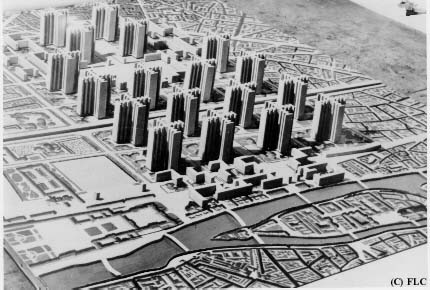
2011 marks the 50th anniversary of Death and Life of Great American Cities by Jane Jacobs. In it, Jacobs attacks the planning methodology of the 1950s and 60s, most notably the Radiant Garden City idea which gained traction about this time. The book is known as the main impetus behind the New Urbanist movement, which questioned many modernist planning techniques.


So what exactly is it that we have learned, and in some cases, failed to learn, from this book? How is the New Urbanist movement set up to cope with some of the issues caused by the recent housing crash?

1) Modernist planning has been discredited: This happened in the early 1970s with the decay of many modernist low income housing projects, notably Pruitt-Igoe and Cabrini-Green. The sheer scale of these developments isolated many people who were previously members of close families and communities. The projects were not able to foster any social development, and no sense of community or ownership developed among the residents.


2) New Urbanism is now mainly an architectural movement: Despite the successes of the New Urbanist movement, the term “New Urbanism” is being widely misused to promote things which are in fact, the exact opposite of what it is about. A residential suburb that is composed of rowhouse style buildings built wall-to-wall is considered “New Urbanist” by many developers and most residents, but it is in fact, not. In order for New Urbanism to work, it must be clearly understood and used appropriately.


3) The public has been given a roll in the planning process: During the mid 20th century, planners were accepted as experts in their field and were not questioned by the public. The New Urbanist movement changed this and public planning meetings are commonplace. However, this has backfired somewhat, as opposition to planning projects is increasing because members of the public do not always understand the goals of a project and the reasons for its proposal.

4) Modernism is not dead yet: While the epoch of Modern architecture may have come to a close, many of the ideas that allowed it to flourish are still in place, automobile dependance, single-use zoning, and the prevalence of suburbs composed of detached, single family houses and shopping malls. These do not provide social benefits, waste resources, and do not create sustained economic development.

5) Urban development (mostly) focuses on the whole of a city, not on specific parts: This is another of Jacobs' main arguments. One reason for the failure of project housing is the fact that it is thought of as project housing, thus creating social perceptions about it and those who live in it.

6) Mass transit is being recognized as a core component of urban development: In the mid 1990s, San Francisco revitalized its waterfront district by tearing down the damaged Embarcadero Freeway and replacing it with a boulevard, pedestrian mall, and light rail/streetcar line that connects Market Street with AT&T park and Fishermans' Wharf. In 2001, Portland, Oregon opened the Portland Streetcar, which has generated over $1 billion in economic development and revitalized areas such as the Pearl District.


7) Subsidy can only work so well: Since the 1930s, mortgages on suburban houses have been subsidized by the Federal Housing Administration. These subsidies artificially inflated the housing market and promoted home ownership to people even when it was not economically optimal for them. This is what created the subprime mortgage market, and thus the recent crash.