Showing posts with label Housing. Show all posts

Wednesday, April 30, 2014

City Planning as a Social Movement, What it Means to be an Urbanist

Throughout the history of city planning, and except for a brief period in the 1960s, it has never directly entered the public mindset as something that can bring about social justice and lead to better living. 


Cities are the building blocks of nations. They are economic powerhouses which have developed or manufactured each and every technological advance in the history of the human race. Cities are the cornerstone of modern society. But cities are even more than that:

“Cities are for people. A place for their hopes and dreams, their work and play, their homes and homes for their children. Cities are alive and have personalities, each different from all others and each in constant change.”
-Richard Bartlett, AIA.

As I note in the banner of this blog, how we design and use our environments directly relate to the quality of interactions we have with and within them. These interactions can include everything from the mundane, such as buying groceries, to the extreme, such as criminal activity.

Cities are built by people and for people. As residents of cities, or as those who have reaped the benefits of cities, we have a responsibility not only to ensure their continued prosperity, but to ensure that the social, economic, and cultural benefits they bring reach the largest number of people and do the greatest amount of good. It is our responsibility to ensure that cities meet the needs of all social and economic groups, that cities can provide safe places for children as well as homes for the elderly. It is our responsibility to ensure that the penthouse apartments for the wealthy do not detract from the provision of housing for those on the margins of society.

Moreso, it is our responsibility to ensure that the economic and societal collapse of the 1960s and 1970s, mainly due to urban decay, does not repeat itself. We must make sure that our cities are resilient, both economically and environmentally. We must build for the desires of the present, while planning for the future; realizing that while bars and nightclubs may be desirable now, schools and grocery stores will be needed in the years to come. 


To this end, ensuring comprehensive multimodal transportation is the responsibility of every citizen, and we all have something to gain from it. Americans spend almost one third of their income on transportation, only to receive increasing commutes, increased stress levels, increased pollution, and longer work days. This is not sustainable in any way. Our love of the automobile has fractured our social networks, brought our environment to the verge of destruction, and caused our lives to revolve around the price of gasoline, not to mention the 30,000 deaths per year as a result of automobile wrecks.


We also have a responsibility to keep our cities free of crime. This does not have to mean an increase in the police force, however. The design of our cities in and of themselves can deter crime, something which was realized as long ago as the 1960s. This, along with a fundamental rethinking of policing strategies, as brought to the table by David Kennedy, is something that it is our responsibility to advocate for. It is the job of a city to bring people together and foster social, as well as intellectual, collaboration regardless of race, class, or gender. Crime does the opposite of this. It separates communities, often across racial lines, and fosters negative stereotypes.


Finally, and on a more personal level, the design of our environment impacts our health. Perhaps the ultimate solution to our healthcare costs lies not in the halls of congress, but in our methods of development. Our fascination with automobiles and drive-throughs has led to an explosion in the popularity of fast food and a dramatic increase in distance between travel points. A recent article in USA Streetsblog notes that only in three cities in the entire country, New York, Philadelphia, and San Francisco, is it possible for a majority of residents to walk to a grocery store in five minutes or less. If we spent more time walking or riding our bicycles to the store and spent less time eating fast food in our cars, perhaps we could reduce our record rates of obesity and heart disease. If we consolidated our development and devoted more money to inner city economic development, perhaps we could alleviate the food desert issue that plagues so many low income communities.


However, none of these aspects can be looked at in their own field of influence. It is impossible to encourage more people to walk or bike in a community that is rife with crime. Likewise, it is impossible to encourage economic development and business investment without building a vibrant and resilient community. Finally, it is downright negligent to constantly mourn victims of mass shootings without paying attention to the fact that the majority of mass shootings occur in suburban areas. 


This is what the idea of urbanism is. Not just understanding the world around us and how we interact with it, but also realizing that the built environment is one that we all influence, whether we realize it or not. To borrow (and modify) a phrase from Matthew Taylor, the Chief Execuitve of the Royal Society for the Arts, I believe that the use of our urban space can “tell us about who we are as human beings, spark political debates about who we need to be, and lead to philosophical debates about who we aspire to be”. The goal of urbanists is to spark and lead these discussions, turning inclusive thought and deliberation into policy.

This sentiment was expressed over 50 years ago by Jane Jacobs, in her landmark book Death and Life of Great American Cities, which brought planning into the realm of the general public for the first time:

“Cities have the capability of providing something for everybody, only because, and only when, they are created by everybody.”


Friday, February 7, 2014

Modernism Revisited, Was Jane Jacobs Right?

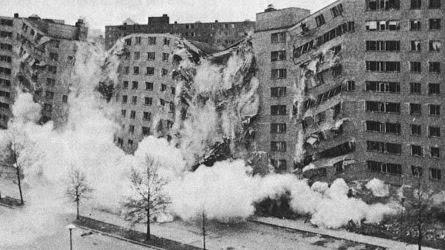
I recently had an opportunity to view the documentary The Pruitt-Igoe Myth, which I touched upon earlier in this blog. In this film, many residents of the infamous public housing development reflect upon the time they lived there, the community that existed, and it's ultimate undoing.

The residents interviewed for the film, some who had lived in the development since the beginning, others who moved in during its period of decline, all noted that throughout the lifetime of Pruitt-Igoe, a strong community developed, first based on the joy and pride that came from living in such a new, modern place, and later as a counter to the decline of the complex and its neglect by local, state, and federal housing officials.  

The documentary notes that what caused the ultimate undoing of the development, a post-industrial city with a declining population, miscalculations of growth, and policy, both formal and informal that maintained the racial segregation of St. Louis's housing stock, keeping African Americans from entry-level jobs, had little to do with the modernist movement, architectural features of the buildings (or lack thereof), or the quality of the community created within them.  

Jane Jacobs, in her landmark Death and Life of Great American Cities notes that housing developments such as these will inherently fail due to their architectural characteristics, such as massive scale, large open spaces with little use, and lack of economic diversity or mixed uses. However, from this documentary it is apparent that such a community did develop, and that, for a time, it was able to benefit and look after the residents of Pruitt Igoe.

Ultimately, the downfall of this community, and the housing complex, was caused by insufficient maintenance, a shrinking population, and a bureaucracy that ultimately was apathetic to such problems as they affected many similar public housing units around the country. In other words, the massive resources that a public housing development of this scale needed to succeed were not available.


In this sense, the point Jacobs makes is that development or refurbishment is most efficient and useful if it occurs in forms already recognized in the neighborhood it is located in, as this development can be supported by existing infrastructure, with existing means. In order to work properly, modernist public housing on a large scale would require massive amounts of continued funding, which would likely be unsustainable.  

Jacobs notes this, and tells the reader that when the word “project” is used to describe such a development, it conjures very specific things, namely that the development, and those who live in it, are fundamentally different than their surroundings. Death and Life of Great American Cities describes in detail how cities can be revitalized by using their intrinsic characteristics, a much less intrusive practice than the modernist approach, and one that is ultimately more sustainable.

In this way, the film's claim that Pruitt Igoe should not be used as an example of modernist failings is somewhat inaccurate. Pruitt Igoe demonstrated that the modernist approach would work as long as large sums of money were provided over the lifespan of modernist developments. The political reality prevented (and continues to prevent) such sums of money being spent on public housing, necessitating a more efficient approach.


It can be argued that Jacobs approach to housing is more practical because it uses the intrinsic features of an urban environment to promote social and economic growth. This prevents unnecessary sums of money being spent on imposing “order” on an “chaotic mess”to use descriptions common amongst modern architects and correcting what is actually a non-problem.  

This is the core reason that large scale public housing complexes such as Pruitt-Igoe should not be repeated, they are the hallmark of construction for construction's sake, and only work if continuously supplied with funding.

Thursday, May 16, 2013

Design Fixation and The City

One development that's undergone much recent study in the field of engineering is the concept of design fixation, the reluctance of a designer to innovate due to their unquestioned adherence to existing ideas or due to the influence of previous designs upon them.

According to a study published by the American Society for Testing and Materials (ASTM), design fixation is often subliminal, and occurring regardless of what instructions are provided to the designer. This often results in a flawed design being, in a large part, copied, despite the designer being told specifically that it is flawed.  


This concept is beginning to manifest itself in several interesting ways in regards to city planning. One of the most apparent is the idea that in order to be competitive and economically resilient, a city should strive on attracting a "creative class" of young professionals, something which recent research shows might not actually work, as opposed to trying to develop one by increasing the quality of education, public services, or low income housing.

Another way is by cities directly copying aspects of comprehensive plans from other cities without optimization or the understanding of why they were originally developed. A good example of this is the implementation of form-based zoning codes aimed at promoting pedestrian friendliness and mixed uses. This is often seen when cities do not provide a reason or direction for their codes, and implement them over large areas of land instead of applying them to specific neighborhoods.


A good example of this is "new urbanist" suburbs which are composed of rowhouses on a grid plan, but do not exist in a larger context. They must still be accessed by car, and still have minimal connectivity to adjacent roads.  


One of the major flaws of the urban renewal program in the 1950s and 1960s was that it tried to apply standardized solutions to a variety of problems across a variety of cities, itself an expression of design fixation. This approach paid no attention to the peculiarities of the urban environment.


Jane Jacobs discussed several flaws with this approach, most notably, the fact that the design of these developments run counter to the way the street level is actually used by a city's inhabitants. She also noted that the interactions that take place among the residents of a city play a large part in keeping it safe, interesting, and economically competitive. Most importantly, she noted that each city has its own peculiarities which influence these interactions. The peculiarities of one city are different than those of another, and thus a planning solution to a particular problem may work in one city, but not in another.

In order to make a substantial effort at addressing the variety of urban problems that face us, such as poverty, crime, and abandonment, the reasons for them, demographic patters, investment and development rates, policing strategies, and travel patterns, must be thoroughly examined and well understood. In this way, each city is unique. A problem that is fundamentally different in two locations cannot be solved with the same solution.

This is what keeps urban design interesting, and I dare say, what makes it fun.


Thursday, February 7, 2013

Urban Living and The Second Suburban Sprawl

A large percentage of new housing units constructed as part of downtown revitalization cater to a two specific groups of people: older "empty nesters" who live alone and do not want to drive, and young professionals, who are often single and want to be near active and "trendy" neighborhoods. A common element in both these groups is that they do not have children, and thus neighborhoods designed to attract them do not cater to the needs of children by providing amenities such as schools, libraries, and playgrounds.  


Because of this, it is likely that many young professionals will move out of cities and back to suburbs should they decide to start families. This will cause yet another round of suburban sprawl and possibly a second wave of urban decay.

In order to lessen the effects of this or prevent it altogether, urban space must be designed and purposed in a way that is inclusive to the needs of current and future residents of all age groups. In some cases, this will result in tradeoffs where a city has to decide whether to allocate resources to schools and public or affordable housing or amenities designed to attract younger residents and tourists to cities.


Despite these tradeoffs, an inclusive built environment has the potential to draw a previously unconsidered demographic to cities, families that live in the suburbs simply because these are the only areas that currently cater to their needs. Making cities attractive for these groups will not only work to reduce suburban sprawl but will also extend the economic and social benefits of urban life to as many people as possible.

Monday, October 29, 2012

An Evaluation of Moving to Opportunity

The subject of this post is a 2001 study by Mark Shroder which explores the results of the Department of Housing and Urban Development's Moving to Opportunity (MTO) program. The program is an experimental implementation of Chicago's Gautreaux Project on a national scale.


The intent of the Gautreaux Project was to allow families living in low income neighborhoods and public housing developments to relocate to higher income neighborhoods in an attempt to better their socioeconomic status. This was initiated after the 1966 court case Dorothy Gautreaux v. Chicago Housing Authority ordered the Chicago Housing Authority to take steps to end segregation in public housing.


This project involved moving participating low income residents from inner-city areas to suburban areas, where neighborhood economic status and school quality were by nature higher because of the presence of higher income individuals and families.

The project found that the group that was relocated had an increased rate of employment and that the children of those that relocated had an increased percentage of high school graduation than those who did not.

MTO has been designed to further explore these findings, and established three classes of participants. A control group that received no housing assistance, a Section 8 comparison group, and a group which received special Section 8 vouchers usable only in areas with a poverty rate of less than 10%. Several cities were included in this experiment, thus eliminating any geographical bias to the results.

In all of these groups, the majority of subjects were African American. Less than 40% of total subjects were employed.


The study noted that most of the applicants had been, or had friends or relatives who had been, victims of crime and that this was their reason for applying to the program. Other reasons included the desire of better schools for children and for larger residences.

Because of these desires, it can be said that the group "self selected", in that those who expressed a desire to leave immediately took advantage of the program, making it difficult to study the effects of MTO on group dynamics and social networks.  


The study also noted that participants were widely dispersed once moved, pointing out that simply re-concentrating poverty in different areas would not solve any problems. It also detailed how not all of the families with the option to move to other areas did so.

Shroder's work then gives summaries of other studies done on the MTO program and attempts to make generalizations from those.

A study by Katz, Kling, and Liebman found that those who relocated felt safer, noticed less neighborhood drug use, had fewer domestic issues, and described themselves as increasingly healthy. This study did not examine poverty or employment.

A study by Ludwig, Duncan, and Pinkston found that those who had relocated were slightly less dependent on welfare than those who did not.
Finally, a study by Leventhal and Brooks-Gunn found that those who relocated had decreased instances of depression and anxiety, and that parenting skills had improved significantly.


Shroder notes that more studies will be needed to determine the effectiveness of the MTO program, but states that the initial research looks promising.

While MTO does seem at least initially to be successful, it comes at the price of disrupting the existing social networks between residents of public housing. Instead of moving low income residents out of a community, higher income residents should be moved in to under-occupied residences. These would allow existing social networks to be strengthened instead of being removed.

Lower income residents also have a stronger attachment to their residences than higher income individuals, as they have fewer options for replacement housing should they be forced to leave.


While Moving to Opportunity was successful at reducing individual poverty, it did little to help poor neighborhoods. This is something that needs to be examined closely, as strong neighborhoods are what allow social networks to develop and for information about job opportunities, educational opportunities, and political organization to be disseminated.

Friday, September 28, 2012

Revitalized Neighborhoods, Social Environments, and Education

A study by Claire Smrekar and Lydia Bentley focuses on the social environments of affordable and public housing as they relate to schools, with both HOPE VI and Section 8 programs being examined.

HOPE VI is the newest generation of public housing policy aimed at meshing public housing with local context. It consists of mixed income housing communities in an attempt to prevent concentrated poverty and to develop community resources, including schools. HOPE VI requires a detailed plan of improvements that will be made to schools adjacent to or within HOPE VI communities, and school performance is directly linked to economic development within a community.


Section 8, on the other hand, focuses only on the housing aspect of a community. The program provides vouchers to residents living in public housing so that they may choose their residence from any number of places with the voucher covering some or all of their rent.


Urban poverty is often seen as a cyclical problem in that poverty and crime are highly correlated, crime discourages investment, which further increases poverty within a neighborhood. The crime created by this can make public space unsafe and preclude the development of social networks, as I noted in my last post, a discussion of David Kennedy's Don't Shoot.

The research notes that the social environment of a community can have a large effect on parenting techniques, which, in turn, can have an extraordinarily large effect on a child's educational motivation. They relate this to the development of social capital within a neighborhood, and note that strong communities with civic organization, youth groups, and churches often contain strong social networks. These social networks serve as couriers of employment or educational opportunities, community news and gatherings, and information about community services.


The study notes that two similar programs, the Gautreaux Project in Chicago, and the Moving to Opportunity Program, on a national level, have tested this theory. The two programs had opposite results. When Gautreaux was implemented, it was shown that the quality of live for residents, especially that of children, improved. However, when Moving to Opportunity was put into place, significantly less quality of live improvement was shown, and almost no educational improvement in children was noticed.


The study examines the Section 8 community first, three out of eight parents who lived in the community noted that they were unemployed, and the average occupancy time was noted to be two years.

Residents noted that the move in process was smooth, but that maintenance services were often unresponsive (sometimes, to the point of enticing residents to move), and that crime was perceived as high. Interestingly, all residents noted that the areas of the community they lived in were safer, and that other parts of the community were the areas with the crime problem. Despite the fact that the physical size of the neighborhood was not excessive, a social gulf was perceived to exist between residents. Many residents thought that the nearby HOPE VI community was safer and quieter.


In the HOPE VI community all residents were employed, and the average occupancy time was noted to be three years. Employment is a condition for living in a HOPE VI community, as the study notes, as are education and a clean criminal record.

Residents of this community noted that there was a set of regulations put in place to prevent dependence and to insure community well being. These involved such things as inspections, removal from the community for nonpayment of utilities, and requiring residents to pay maintenance fees for tasks they could have accomplished themselves. 

The study notes that the HOPE VI community was more personal and empathetic throughout the housing application process and while connecting residents with social services.

The HOPE VI community was perceived by all margins as extremely safe, with all residents allowing children to play outside (some with supervision, however), and several residents being unafraid to go outdoors after dark. Many residents noted that the social network within the community was key to providing most of this safety.


While many residents of the HOPE VI community did not discuss development of close relations with neighbors, it was noted that the level of social interaction was significantly higher than in the Section 8 neighborhood, and community events were organized to promote this.


Overall, the study notes that HOPE VI communities have higher social networking potential over Section 8 communities, and that these social ties generated a stronger community which could work more effectively for the benefit of its residents. However, correlations between this community development and the strength of the nearby school were not directly measured, for undisclosed reasons.

Thursday, August 23, 2012

A New Approach to Urban Crime Control

A recent book by David Kennedy titled Don't Shoot, One Man, a Street Fellowship, and The End of Violence in Inner City America puts a new face on the fight against urban drug and gun violence. In the book, Kennedy discusses his new approach for combating such violence, which he notes has been implemented in cities such as Boston, Cincinnati, Chicago, and Los Angeles. The approach to violent crime detailed in this book involves identifying a small group of worst offenders, arresting the worst of those, usually with Federal assistance, and then holding community dialogue with the rest and informing them that if they do not stop their acts of violence they will meet a similar fate.


Kennedy notes that when these methods, since given the name “Ceasefire”, were enacted, the type of crime targeted dropped noticeably and swiftly.

In addition, he notes that the presence of so much violent crime for so long has severely damaged urban neighborhoods, both economically and socially. Kennedy points out that none of the economic, social, or racial problems affecting these communities can be addressed until the crime that permeates them is controlled in a lasting manner. However, he does not give any indication of when a community might be ready to move on to those tasks.


The book points out that the structure of violent activity is the same from city to city, regardless of the size, number, or ethnic makeup of gangs. Kennedy details how the majority of violent activity can be directly traced to a small group of core gang members, the most violent of these members can be targeted with policing in cooperation with federal authorities, and the rest can then be targeted with community outreach. Kennedy describes how round-table meetings were held with local, state, and federal police, prosecutors, community activists, and gang members. In these meetings, authorities explained to the gang members the gravity of the charges that could be brought against them if their actions continued, which, he noted, many offenders were unaware of. Community organizers explained the damage that years of criminal activity and accidental killings of children have wrought on communities, and the fear it brings to parents. These meetings also offer support services, such as housing and job opportunities, to replace income from selling drugs or other criminal activities.


Kennedy notes that this approach has been implemented to target various crimes, from shootings to drug markets to domestic violence, in a large number of cities and has been extremely successful.


However, he also discusses the political turbulence associated with such implementation, noting that in some cities, political shifts or changes in police department personnel can cause the program to lapse and be discarded. Other times, city administrators can be hostile to outside ideas, and try to stonewall their progress or simply ignore them. Kennedy notes that this happened in Baltimore, but since the program has developed and become more widely implemented, it was adopted there as well.

Kennedy's book presents an original perspective on the issue of urban crime, and one which has immediate and significant impact. His book should prove to be pivotal in the fight against crime, and a starting point in rebuilding communities and making urban areas more attractive places to live.


Thursday, May 31, 2012

Neighborhood Violence and Gated Communities

One thing that should be discussed in the wake of the Trayvon Martin shooting and the subsequent trial of George Zimmerman, and that should also enter the discourse given America's abnormally high gun crime rate, is the role of neighborhood design in public safety.


Trayvon Martin (an African American) was killed in a gated community by a man, George Zimmerman (Caucasian and Peruvian), who claimed only that he “looked suspicious”.


Discussion on the nature of this event has focused primarily on Martin's appearance, Zimmerman's actions and previous history with law enforcement, racial politics, and weapons usage. However, almost no attention was paid to the location of the crime.

The purpose of a gated community is to keep criminals out, an objective that is met with mixed results. A side effect of this is that anyone who is not immediately recognizable is viewed suspiciously and assumed to be undesirable. This is especially problematic with minorities, who are generally viewed as lower-income and predisposed to criminal behavior. This was the case with Trayvon. Zimmerman is believed to have asked him what his purpose for being in the neighborhood was after Trayvon asked Zimmerman why he was following him.

In addition to this, it is worth examining the typical resident of a gated community. Often, personal safety is their number one priority (hence the gates), and not necessarily solid community building. This same group is also a vigorous supporter of gun ownership. This is another important aspect of the Trayvon Martin shooting, local police urged George Zimmerman to procure a firearm several months prior to the shooting taking place.

Another aspect that comes into play is the weapons effect, which notes that the presence of weapons (usually firearms) can aid in rapidly accelerating violent scenarios, even if the weapons are not actually used in commission of those acts.


These circumstances can combine to create communities with unusually high senses of fear and paranoia, despite the illusion of safety offered by limited access to the community. This is evidenced by the fact that crime rates in gated communities are on par with crime rates in non-gated communities.

All of these factors combined can create a vicious cycle of violence. Criminal activity can incite senses of fear, which can lead residents of the community to procure weapons. The presence of these weapons can later lead to commission of more violent acts, which can then lead residents to buy more weapons. It seems that this is what happened in the case of Trayvon Martin.

Wednesday, August 3, 2011

6 Ways Urban Development Impacts You (and why Suburban Development is Bad)

1) Money: The amount of money you spend on transportation expenses relative to income increases with the number of cars you own. This is due to acquisition costs, fuel, and maintenance. This means that the farther away from your job you live (i.e. the more you spend on fuel and the more necessary multiple cars become) the less money you have to spend on other needs or to save. Mixed use zoning, transit oriented development, and high quality public transportation can reduce these costs. In addition to this, suburban housing is subsidized to an extent by the Federal Housing Administration and the loans it provides and guarantees towards single family homes, thus the true costs of suburban housing are hidden from the homeowners. These loans cannot be used to purchase residencies in multi-unit buildings and similar incentives are not available to renters.


2) Health: The lifestyles encouraged by different development types vary wildly. Suburban development is based on the car, which means minimal walking and lots of fast food restaurants. Urban development is pedestrian friendly, encouraging walking and transit use. However, the increased consumption of fast food and decrease of physical activity due to primarily suburban development patterns have put strain on our medical system. In addition to this, the long commutes created by automobile centric development have an adverse impact on mental health, as they cause levels of stress to increase, which in turn can cause violent behavior and loss of workplace productivity.


3) Reenforcing or Breaking Stereotypes: Due to the factors that were in play before and during the beginning of suburban growth, poverty has become unfairly synonymous with race. Ethnic minorities are almost always depicted as being impoverished, while Caucasians are almost always depicted as being wealthy. This has then created another unfair relationship between ethnic minorities and predisposal to criminal behavior, causing public housing projects and mixed income projects to be opposed along racial lines, thinking that they will bring crime. These same projects, if successful, will bring their occupants out of poverty regardless of race, and can be used to break these unfair depictions of ethnic minorities.


4) Quality of One's Living Environment: In addition to the health and economic effects of automobiles, large quantities of cars can also create low quality living environments. Large roads and freeways create noise and light pollution, and parking lots use land that could be developed or used for parks. In addition to this, pollution from cars creates smog and poor air quality, leading to additional health issues.

5) Decrease in Quality of Public Services: As the density of development decreases and the amount of land consumed by it increases, applicable services such as police and fire departments, schools, and utilities become more expensive and less efficient because they have to cover more ground. Since the fiscal needs of these organizations are not adequately met, their quality becomes unevenly distributed and overall quality decreases.

6) Crime: Sound urban development and urban revitalization includes use of tools such as mixed income housing, mixed use development, and transit oriented development. These serve to bring investment and people to the areas they are built in. The high presence of people and mix of uses serves as a deterrent for crime because they provide public surveillance of the street space and property.

Friday, July 22, 2011

Is Gentrification Good?

One aspect of New Urbanism that is often discussed is gentrification and the role it supposedly plays in making neglected areas of cities attractive again. However, its danger comes with the fact that it has potential to uproot current residents of the area being gentrified, and to replace current services with ones that will seem to be beneficial to the new residents.

These issues manifest themselves in the way that wealth (and the lack thereof) are personified in American society. Middle and high income residents are likely to be white, and low income residents are likely to be ethnic minorities.


And herein lies the problem. The economic issue of gentrification (middle and high income people moving into an area of investment and displacing the lower income groups who used to live there) is suddenly turned into a racial issue, where white residents are seen as kicking black residents out of their houses and forcing them to move elsewhere, either into other neglected areas or into public housing.


Because of this, gentrification areas and building public or affordable housing can sometimes be opposed along racial lines.  

The solution to this conundrum lies in breaking the perceived link between ethnic minorities and poverty, and thus ethnic minorities and criminal activity.


This can be accomplished through rebuilding an area while maintaining its architectural style and building public housing units interspersed with market rate housing units, allowing public housing units to be distributed to tenants in the form of vouchers. The value of the vouchers would decrease as the residents' income increased until the residents could own the property outright.  

Yet another way to determine whether a unit would be market rate or public housing would be to make every other unit that comes up for sale in a neighborhood public or market rate.

Either way, there should be no architectural differences between the public and market rate units. Doing such would create the opinion that occupants of public housing are by some means inferior to occupants of market rate housing.

Good public housing should not keep the poor in poverty.

Taking the approach of sandwiching public housing between units of market rate or affordable housing would both confer the social benefits of mixed income housing to the lower income residents and eliminate the stereotype of racial groups being predisposed to poverty or crime.

A good way to picture this would be to imagine side streets with rowhouses along them, every other rowhouse on one side of a street would be public housing, and the same for the other side of the street. Main avenues would be bordered by mixed use development with some commercial office space thrown in.

If you take away one thing from this article, it should be the following:

Ethnic minorities do not cause crime, poverty causes crime.

Saturday, July 9, 2011

The Pruitt-Igoe Myth: A Movie

I came across this video some time ago, it is the trailer for a movie called The Pruitt Igoe Myth detailing the legacy and misconceptions of it's titular infamous housing project. I have not gotten a chance to view this movie yet, but this era is one of the most pivotal and most interesting in the history of urban development.


The things depicted in this trailer and covered in this movie are the reason we do this. We advocate for responsible growth not because we want to force people out of houses, institute communism, or bring about a world government. We do it because it is our responsibility to make sure what happened fifty years ago never gets wrought on humanity again.